Integrating Environmental, Social, and Economic Impact into the Project Lifecycle
1. Executive Overview
PRiSM® (Projects integrating Sustainable Methods) is a comprehensive framework developed by GPM Global (Green Project Management) that integrates sustainability principles into project management practices. It moves beyond traditional project management by prioritizing the Triple Bottom Line: People, Planet, and Prosperity.
Unlike conventional methodologies that focus solely on outputs, PRiSM® ensures that the project's impact—both during execution and after completion—is positive and measurable.
Purpose: To enable organizations to deliver projects that create positive environmental, social, and economic impacts while achieving traditional project objectives.
2. The Core Philosophy: The P5® Standard
The P5 Standard is the foundation of PRiSM®, providing a structured framework to measure sustainability across five key dimensions. It transforms abstract ESG (Environmental, Social, Governance) goals into data-driven project metrics.
People (Social): Focuses on labor practices, health and safety, community impact, and human rights
Planet (Environmental): Focuses on carbon footprint, waste management, biodiversity, and resource consumption
Prosperity (Economic): Focuses on ROI, business agility, local economic impact, and long-term viability
Product Impact: Evaluates the sustainability of the final deliverable throughout its entire lifespan
Process Impact: Evaluates the sustainability of the project management activities themselves (e.g., travel, energy used during construction)
3. The PRiSM® Extended Lifecycle
PRiSM® extends the traditional project lifecycle to include critical pre-project and post-project phases, ensuring that sustainability is baked into the DNA of the initiative and realized over the long term.
Pre-Project: Strategic alignment with UN Sustainable Development Goals (SDGs) and initial sustainability feasibility studies
Discovery: Stakeholder mapping (including NGOs and local communities) and setting sustainability KPIs
Design: Material selection and "Circular Economy" design—ensuring the product can be reused, recycled, or safely decommissioned
Delivery: The execution phase, where "Process Sustainability" is monitored (e.g., fair labor practices and site waste reduction)
Closure: Orderly decommissioning and the production of a final Sustainable Outcome Report
Post-Project: Monitoring benefit realization (e.g., energy efficiency or social improvement) for 10+ years after handover
4. Strategic Implementation Tools
The Sustainability Management Plan (SMP)
The SMP is the master document for a PRiSM® project. It serves as a "living" plan that defines:
Specific Sustainability Objectives: (e.g., "90% of materials sourced from local suppliers within 50 miles")
Accountability Map: Assigning specific sustainability roles and responsibilities to the project team
ESG Reporting: Defining how performance data will be disclosed to stakeholders and regulators
The P5 Impact Analysis (P5IA)
A data-driven scoring engine used at every stage-gate.
Methodology: Each project element is scored from -3 (High Negative Impact) to +3 (High Positive Impact)
Risk Mitigation: Any negative score acts as a "Sustainability Red Flag," requiring immediate mitigation strategies or executive intervention before the project proceeds
5. The 6 Core Principles of PRiSM®
Commitment and Accountability: Adhering to professional ethics and organizational values
Ethics and Decision Making: Supporting organizational values and promoting fairness
Integrated and Transparent: Fostering honesty and transparency in all reporting
Principal and Values Based: Balancing the P5 elements to achieve the best sustainable outcome
Social and Environmental Equity: Ensuring fairness in resource use and community impact
Economic Prosperity: Ensuring the project is financially viable without compromising future generations
6. Why PRiSM® Matters in Modern Project Management
Studies show that nearly 70% of projects fail due to poor planning and wrong execution approach. PRiSM® addresses this by:
Transforming sustainability from abstract goals into measurable project metrics
Extending accountability beyond project closure to long-term benefit realization
Aligning projects with UN Sustainable Development Goals (SDGs)
Providing data-driven tools (P5IA) for continuous sustainability assessment
Best Used For: Infrastructure projects, construction, manufacturing, energy projects, and any initiative where environmental and social impact is critical to success and organizational values.
Integration with Other Methodologies: PRiSM® can be combined with traditional methodologies (Waterfall, Agile, PRINCE2) to add the sustainability dimension while maintaining existing project management structures.
SAFe 6.0
SAFe 6.0 Framework Overview
SAFe (Scaled Agile Framework) is the "heavy lifting" version of Agile designed for massive organizations. It's essentially how you take Agile from a single team to an entire enterprise.
Why SAFe Matters:
Moving into SAFe is a big step—it bridges the gap between "Small Agile" (Scrum/Kanban for individual teams) and "Big Agile" (coordinating multiple teams). While a single team uses Scrum, a "Team of Teams" uses SAFe.
Core Competencies of Business Agility:
Team and Technical Agility - High-performing teams with technical excellence
Agile Product Delivery - Customer-centric approach to building solutions
Enterprise Solution Delivery - Building large-scale software and cyber-physical systems
Organizational Agility - Business solutions with Lean startup methods
Continuous Learning Culture - Innovation and relentless improvement
Lean-Agile Leadership - Leading the transformation
The Agile Release Train (ART):
Team of Agile Teams - Multiple teams working together
PI Planning - Program Increment planning events
Sync Events - Regular synchronization ceremonies
Key Roles:
Release Train Engineer - Servant leader for the ART
Product Management - Content authority for features
System Architect - Technical leadership
Business Owners - Business decision makers
10 Lean-Agile Principles:
Take an economic view
Apply systems thinking
Assume variability; preserve options
Build incrementally with fast, integrated learning cycles
Base milestones on objective evaluation of working systems
Limit WIP, reduce batch sizes, and manage queue lengths
Apply cadence and synchronize with cross-domain planning
Unlock the intrinsic motivation of knowledge workers
Decentralize decision-making
Organize around value
Best Used For: Large-scale enterprise software development (50+ people), organizations with multiple Agile teams needing coordination, and financial services/regulated industries requiring Agile with governance. Best for companies building platforms or large product suites requiring portfolio-level visibility.
Agile & Scrum
Agile & Scrum Framework Overview
Agile is not a single methodology but a philosophy defined by the Agile Manifesto. It prioritizes people, working solutions, and responsiveness over rigid plans. Scrum is the specific framework that turns this mindset into a repeatable rhythm through defined roles and time-boxed Sprints.
The Agile Manifesto - 4 Core Values:
Individuals and Interactions over processes and tools
Working Software over comprehensive documentation
Customer Collaboration over contract negotiation
Responding to Change over following a plan
12 Agile Principles:
Continuous Delivery - Satisfy customers through early and continuous delivery
Welcome Change - Embrace changing requirements, even late in development
Frequent Delivery - Deliver working software frequently (weeks rather than months)
Daily Cooperation - Business people and developers work together daily
Motivated Individuals - Build projects around motivated individuals
Face-to-Face Conversation - Most efficient method of conveying information
Progress via Software - Working software is the primary measure of progress
Sustainable Development - Maintain a constant pace indefinitely
Technical Excellence - Continuous attention to technical excellence
Simplicity - Maximize the amount of work not done
Self-Organizing Teams - Best architectures emerge from self-organizing teams
Regular Reflection - Team reflects on how to become more effective
The Agile-Scrum Connection
While Agile provides the philosophy and values, Scrum provides the practical structure to implement Agile principles. Scrum is the most widely adopted Agile framework, offering specific roles (Product Owner, Scrum Master, Developers), events (Sprint ceremonies), and artifacts (Backlogs, Increments) that turn Agile values into actionable processes.
For detailed coverage of Scrum's 3-5-3 structure, ceremonies, and implementation, see the dedicated Scrum Framework methodology.
Waterfall
Waterfall Project Management Overview
Waterfall is a traditional, linear project management methodology where each phase must be completed before the next begins. It follows the principle of "Measure twice, cut once" - perfect for projects where requirements are well-understood and changes are costly (e.g., construction, manufacturing, bridge building).
Core Philosophy:
Linear Path - Sequential phases that flow downward like a waterfall
100% Completion Requirement - Each phase must be fully completed before moving to the next
Fixed Scope - Requirements are frozen early and changes are controlled through formal processes
High Documentation - Comprehensive documentation at each phase ensures clarity and traceability
Standard Phases:
Requirements - Gathering user needs and creating the SRS (Software Requirements Specification) document
Analysis & Design - System architecture, technical specifications, and design documents
Implementation (Build) - Actual development and construction of the solution
Testing (Verification) - Post-build checking to ensure quality and requirements are met
Deployment (Installation) - Rolling out the solution to production environment
Maintenance - Ongoing support, bug fixes, and minor enhancements
Gate System:
Stage-Gate Reviews - Formal checkpoints between phases
Stakeholder Approval - Senior management sign-off required to proceed
Deliverables - Specific outputs must be completed at each gate
Attributes & Constraints:
Planning Tools:
Critical Path Method (CPM) - Identifies the longest sequence of dependent tasks
Task Dependencies - Maps which tasks must be completed before others can start
Risk Profile:
Early Identification - Problems caught in planning phase are cheaper to fix
"Big Bang" Delivery - Everything delivered at once (high risk if requirements were wrong)
Late Failure Discovery - Testing happens late, making fixes expensive
Physical construction projects (buildings, infrastructure)
Projects where changes are very expensive
The Structure: Waterfall represents "The Skeleton" - the fundamental structure that holds a project together through defined phases and formal controls.
Best Used For: Construction and infrastructure projects, manufacturing with fixed specifications, government contracts with strict compliance requirements, and projects with well-defined, stable requirements. Best for initiatives where predictability, documentation, and sequential execution are more important than flexibility.
Scrum Framework
Scrum Framework Overview
Scrum is a lightweight Agile framework designed to help teams solve complex problems and deliver high-quality products incrementally through iterative cycles known as Sprints.
The Mindset vs. The Mechanics:
In project management, we say Agile is the "Mindset" (the values and principles) while Scrum is the "Mechanics" (the roles, events, and artifacts). Scrum provides the specific structure to implement Agile philosophy.
Core Purpose: Transform complex challenges into incremental value through a disciplined yet adaptive professional environment. By operating in short, fixed periods (Sprints), the methodology ensures a rhythm of constant delivery and regular opportunities for self-correction.
The 3-5-3 Structure of Scrum:
Scrum is defined by 3 Roles, 5 Events, and 3 Artifacts.
The 3 Accountabilities (Roles):
Product Owner - Accountable for maximizing product value and managing the Product Backlog
Scrum Master - Responsible for team effectiveness, coaching on Scrum theory and practice, establishing Scrum as servant-leader
Developers - The professionals who create a usable "Increment" each Sprint; self-managing team
The 5 Events (Ceremonies/Lifecycle):
The Sprint - The 1-4 week "heartbeat" where work happens (time-box: one month or less)
Sprint Planning - Team plans work for the current Sprint (value of Sprint, work selection, work execution plan)
Daily Scrum - 15-minute daily check-in to inspect progress and adapt Sprint Backlog
Sprint Review - End-of-Sprint session to inspect outcome and determine future adaptations
Sprint Retrospective - Private team meeting to increase quality and effectiveness
The 3 Artifacts & Commitments:
Product Backlog - Master list of everything needed in the product
Commitment: Product Goal
Sprint Backlog - Specific items chosen for the current Sprint
Commitment: Sprint Goal
Increment - The "Done" work that adds value to the product
Adaptation - Process adjustment, material adjustment
Originally created for software development, Scrum is now widely applied across various industries, including marketing, manufacturing, and healthcare.
Kanban Framework
Kanban Framework Overview
Kanban is the perfect complement to Scrum - while they both fall under the Agile umbrella, Kanban focuses on flow and continuous delivery rather than the time-boxed "Sprints" of Scrum.
Key Difference from Scrum:
Scrum: Roles and ceremonies, time-boxed sprints, batch delivery
Kanban: Flow and WIP limits, continuous delivery, pull-based system
Core Philosophy: Visualize work, limit work in progress, and manage flow to optimize the delivery system. Kanban is about evolutionary change - start with what you do now, respect current roles and responsibilities, and pursue incremental improvements.
Foundational Principles:
Start with current processes - Begin where you are, no need to reorganize
Pursue evolutionary change - Small, continuous improvements over radical transformation
Respect current roles - No prescribed roles like Scrum Master or Product Owner
Encourage leadership at all levels - Everyone can suggest improvements
6 General Practices:
Visualize the workflow - Make all work visible on a Kanban board (To Do, In Progress, Done)
Limit Work in Progress (WIP) - Control how many items can be worked on simultaneously to prevent overload
Manage flow - Monitor, measure, and optimize the movement of work through the system
Make process policies explicit - Define and communicate how work moves between stages
Implement feedback loops - Regular reviews and retrospectives to identify improvements
Improve collaboratively - Use models and scientific method to evolve the system
Key Metrics:
Lead Time - Total time from request to delivery
Cycle Time - Time spent actively working on an item
Throughput - Number of items completed in a time period
Terminology:
Kanban Board - Visual representation of work flow with columns representing stages
Bottleneck - Stage in the workflow where work accumulates and slows down
Kaizen - Japanese philosophy of continuous improvement
Best Used For: Teams wanting continuous flow, support/operations work, maintenance projects, or organizations that can't adopt time-boxed sprints. Kanban works well when work items vary in size and priority changes frequently.
PRINCE2 7th Edition
PRINCE2 7th Edition Framework Overview
PRINCE2 (PRojects IN Controlled Environments) remains the gold standard for high-governance environments. It is a product-based methodology that places "Accountability" and "Business Justification" at the center of every decision.
Strategic Value: PRINCE2 provides the "Governance Crust" - it defines the stages and gates that senior management needs for oversight, even if teams inside those stages are working with Agile or Lean.
The 5 Integrated Elements:
Principles - The 7 "rules" that must always be followed
People - Focus on leadership, culture, and team collaboration
Practices - (Formerly Themes) 7 areas of management addressed continuously
Processes - The chronological lifecycle steps from pre-project to closing
Project Context - Ensuring the methodology is tailored to the environment
The 7 Principles (Obligations - The "Must-Haves"):
Continued Business Justification - A valid Business Case is mandatory at all times
Learn from Experience - Lessons must be documented and applied
Defined Roles & Responsibilities - Clear hierarchy (Board, Manager, Team)
Manage by Stages - Breaking the project into manageable chunks with gates
Manage by Exception - High-level involvement only when tolerances are breached
Focus on Products - Defining the "what," not just the "how"
Tailor to Suit - Adapting the rules to fit the project's size and complexity
The 7 Practices (The "What We Do"):
Business Case - Ongoing justification and viability
Organizing - Structure, roles, and responsibilities
Plans - Product-based planning approach
Quality - Quality management and control
Risk - Risk identification and management
Issues - Issue and change control
Progress - Monitoring and reporting
The 7 Processes (Lifecycle):
Starting Up (SU) - Pre-project initialization
Directing (DP) - Project Board governance throughout
Initiating (IP) - Detailed planning and Business Case
Controlling a Stage (CS) - Day-to-day stage management
Managing Product Delivery (MP) - Work package control
Managing a Stage Boundary (SB) - Planning next stage and reviewing current
Closing (CP) - Formal closure and handover to Service/Operations
Performance Dimensions (The 7 Variables):
Time
Cost
Quality
Scope
Benefits
Risk
Sustainability (NEW in 7th Edition) - Now sits alongside the traditional six as a variable that must be balanced and managed
Key Innovation in 7th Edition: Sustainability is now a first-class performance dimension. Management decisions and tolerances must account for sustainability targets alongside time, cost, quality, scope, benefits, and risk.
Best Used For: Large-scale projects, government contracts, highly regulated industries, and any environment requiring strong governance, accountability, and clear stage-gate approvals.
Hybrid Approaches
Hybrid Management Framework Overview
This is the "Final Boss" of project management methodologies. In the 2026 landscape, almost no organization is "Pure Agile" or "Pure Waterfall." Instead, they use a Hybrid model - using Waterfall for high-level governance and budgeting, while using Agile for actual execution.
Core Philosophy: The Hybrid Management Framework serves as a strategic bridge designed to harmonize the rigid structure of traditional project governance with the rapid, iterative nature of modern delivery. It's the "Translation Layer" between these two worlds.
The Dual-Layer System:
Waterfall Macro-Layer - Provides stakeholders with financial predictability and fixed milestones
Agile Micro-Layer - Allows development teams to remain flexible and responsive through iterative delivery
Why Use Hybrid?
Stakeholder Comfort - Clients often want a "fixed date" (Waterfall), but teams need "flexibility" (Agile) to handle technical unknowns
Governance - Allows the project to fit into rigid governance frameworks like PRINCE2/PMP while teams remain fast and iterative
Best of Both - Combines stability and predictability of Waterfall with the flexibility and speed of Agile
PMP Principles Integration:
7th Edition: Principle-based Mindset - Stewardship, Systems Thinking, Tailoring, Complexity & Risk, Value & Stakeholders
Structured Planning - Upfront WBS or Gantt charts establish clear milestones and dependencies
Iterative Execution - Core work handled in 2-4 week cycles for continuous feedback and testing
Balanced Control - Managers maintain cost and timeline oversight (Waterfall metrics) while monitoring team speed (sprint velocity)
Implementation Steps:
Assess Requirements - Identify which parts are fixed/regulatory (Waterfall) vs. uncertain/evolving (Agile)
Define Boundaries - Clearly decide where Waterfall planning ends and Agile iterations begin
Unified Tooling - Use platforms like Jira, monday.com, or TeamGantt that support both Kanban boards and Gantt charts
Continuous Evaluation - Hold retrospectives to adjust the "blend" if methodology feels too rigid or chaotic
Common Hybrid Models:
Agile-Waterfall (Agifall) - Most popular mix: high-level requirements and budgeting follow Waterfall, but development and testing occur in Agile sprints
Water-Scrum-Fall - Waterfall for upfront planning, Scrum for execution, Waterfall for final deployment/release
Agile-Stage-Gate - Maintains traditional Stage-Gate checkpoints for funding while utilizing Agile sprints between gates
Scrumban - Purely Agile hybrid blending Scrum's structured events with Kanban's continuous workflow and "pull" system
PRINCE2-Scrum - Combines rigorous governance and roles of PRINCE2 with iterative delivery of Scrum
Regulated Industries - Need for compliance checkpoints without sacrificing innovation
Formal Audit Requirements - Documentation gates with fast delivery cycles
The Protective Buffer: This dual-layered system creates a protective buffer that satisfies the corporate need for stability while embracing the practical necessity of adaptive, modern software engineering.
Best Used For: Organizations transitioning from Waterfall to Agile, projects with fixed regulatory/compliance requirements but evolving technical needs, and government contracts requiring stage-gate approvals. Ideal for any initiative requiring the "best of both worlds" - combining governance with agility.
Lean Six Sigma
Lean Six Sigma Overview
Lean Six Sigma is the "Efficiency Engine" that combines two distinct philosophies to improve processes and eliminate defects. While PMP and PRINCE2 focus on managing the project, Lean Six Sigma focuses on improving the process itself.
The Two Components:
Lean - Focuses on speed and the removal of "waste" (Muda)
Six Sigma - Focuses on quality and the reduction of "variation" (Sigma)
Strategic Value: Provides the metrics and performance measurement that other methodologies require. Answers "How do I make this process faster and better?" Integrates with PRINCE2's "Managing Product Delivery" and PMP 8th Edition's "Measurement Domain."
DMAIC Roadmap (The Core Process):
Define - Problem identification, project goals, customer requirements (CTQ - Critical to Quality)
Measure - Data collection, establish process baseline
Analyze - Root cause identification using Fishbone Diagram and 5 Whys
Control - Monitoring, standard operating procedures to sustain improvements
8 Wastes (DOWNTIME) - The Lean Focus:
Defects - Errors requiring rework
Overproduction - Making more than needed
Waiting - Idle time in processes
Non-Utilized Talent - Underusing people's skills
Transportation - Unnecessary movement of materials
Inventory - Excess stock or work-in-progress
Motion - Unnecessary movement of people
Extra-Processing - Doing more work than required
Key Tools & Concepts:
Kaizen - Continuous improvement philosophy
Standard Work (Consistency) - Documented best practices
Poka-Yoke - Mistake-proofing mechanisms
Belt System - Certification levels:
White/Yellow - Awareness and basic knowledge
Green - Project leader for smaller initiatives
Black - Advanced expert leading major projects
Master Black Belt - Strategic coach and mentor
Integration Examples:
With PRINCE2 - Apply Lean waste identification during "Managing Product Delivery" stage
With Agile - Use DMAIC to find bottlenecks in sprint workflows or slow JIRA processes
With PMP - Provides the metrics for PMP 8th Edition's "Measurement Domain"
With Kanban - Identify and eliminate waste in flow processes
Performance Questions Lean Six Sigma Answers:
How do I reduce defects in deliverables?
Where is waste hiding in my process?
Why is this workflow slower than expected?
How do I sustain quality improvements?
What metrics should I track for continuous improvement?
Best Used For: Manufacturing and operations excellence, process optimization projects, quality improvement initiatives, reducing cycle time, eliminating waste in any repeatable process, and providing data-driven decision making.
Trello
Trello Overview
Trello is primarily a software tool rather than a methodology, but it's specifically built to support and operationalize established Agile frameworks, particularly Kanban.
Core Identity: A "lightweight" visual collaboration tool focused on simplicity and ease of use. It represents the Visual Management layer of project management.
The Gateway Tool: Often the "gateway" for teams moving from Waterfall to Agile because of its tactile, "sticky-note" interface. Designed for Speed and Visibility - The Team Favorite.
Methodology Support:
Core Design - Implementation of the Kanban system using "boards, lists, and cards" metaphor
Framework Limitations - Lacks native support for rigorous features like sprints or advanced Agile reporting
Adaptability - Often described as a "stepping stone" to more structured methodologies; can be loosely adapted without enforcing strict rules
Structural Hierarchy:
Workspaces - Team grouping for organizational structure
Boards - Project canvas representing a workflow or initiative
Lists - Workflow stages (e.g., To Do, Doing, Done) or information categories
Cards - Task units with descriptions and due dates
Agile Tools Integration:
Story Points - Estimate complexity and effort
WIP Limits - Control work in progress (Kanban principle)
Power-Ups & Automation:
Calendar View - Timeline visualization of due dates
Butler Automation - Logical triggers and auto-moving cards based on rules
Collaboration Features:
Checklists - Break down tasks into sub-items
Color-coded Labels - Visual categorization and prioritization
Activity Feed - Track changes and updates in real-time
Key Use Cases:
Personal Productivity - Individual task management and goal tracking
Project Tracking - Team collaboration on deliverables and milestones
Brainstorming - Capture and organize ideas visually
Kanban-Style Logic: Trello uses the fundamental Kanban principle of visualizing work across workflow stages. Cards flow from left to right through lists, making bottlenecks and progress immediately visible to the entire team.
Integration with Other Methodologies:
With Scrum - Can track sprint backlogs using lists for "Sprint Backlog," "In Progress," "Testing," "Done"
With Kanban - Natural fit; boards directly implement Kanban visualization
With Hybrid - Useful as the Agile micro-layer execution tool while maintaining Waterfall governance above
Best Used For: Small to medium teams, simple workflows, visual learners, quick setup without training, collaborative environments, and teams transitioning from traditional to Agile approaches.
JIRA
JIRA Overview
JIRA is primarily a software tool rather than a methodology, but it has become "The Digital Framework" that enforces how Agile, Scrum, and Kanban actually function in modern project management (especially for 2026 R&D).
JIRA's Place in the Ecosystem:
PMP/PRINCE2 = The Governance (The Boss)
Agile/Scrum = The Methodology (The Brain)
JIRA = The Tool (The Hands)
Core Identity: A robust, "heavyweight" tool designed for teams requiring deep structure and detailed tracking. Built specifically to operationalize established Agile frameworks.
Methodology Support:
Natively Built for Agile - Out-of-the-box support for Scrum and Kanban frameworks
Core Framework Features - Specialized support for Scrum ceremonies and artifacts: backlog grooming, sprint planning, burndown charts, velocity reports
Traditional Alignment - Can be adapted for Waterfall or hybrid approaches through customizable workflows and plugins
Issue Hierarchy:
Project - Container for all work items
Epic - Large body of work spanning multiple sprints
Story/Task/Bug - Individual work items
Subtask - Breakdown of stories for detailed tracking
Agile Artifacts:
Backlog - Prioritized list of all work items
Board - Visual workflow representation (supports both Scrum and Kanban)
Sprint - Time-boxed iteration in Scrum mode
Workflow - Customizable status progression (To Do → In Progress → Done)
Reporting & Insights:
Burndown Chart - Track remaining work vs. time in sprint
Velocity Chart - Measure team's completed story points per sprint
Control Chart - Monitor cycle time and identify bottlenecks
Cumulative Flow Diagram - Visualize work distribution across workflow stages
Automation & Integration:
JIRA Automation - No-code rules for automatic actions and transitions
Confluence Integration - Link project requirements and documentation directly to issues
Third-Party Integrations - Connect with Slack, GitHub, Bitbucket, and hundreds of other tools
Comparison with Trello:
Trello - Lightweight, simple, visual, great for small teams and quick setup
JIRA - Heavyweight, structured, powerful, ideal for complex projects and enterprise-scale teams
Key Strengths:
Enforces Agile discipline through built-in structures
Comprehensive reporting for data-driven decisions
Highly customizable workflows and fields
Scales from small teams to enterprise portfolios
Deep integration ecosystem
Integration with Methodologies:
With Scrum - Native sprint planning, ceremonies, and artifacts built-in
With Kanban - Board view with WIP limits and continuous flow
With Hybrid - Custom workflows bridge Waterfall governance with Agile execution
With SAFe - Advanced Roadmaps (formerly Portfolio) support Program Increment planning
With Lean Six Sigma - Control charts and flow diagrams support DMAIC analysis
Best Used For: Software development teams, complex projects requiring detailed tracking, organizations needing robust reporting, teams practicing Scrum or Kanban at scale, and enterprises requiring audit trails and compliance tracking.
The Digital Enforcer: JIRA doesn't just track work - it enforces the discipline of Agile methodologies through its structure, making abstract framework concepts concrete and actionable.
PMP 7th & 8th Edition
PMP 7th & 8th Edition - Professional Standards Overview
PMP (Project Management Professional) represents The Professional Standard & Values - the ethical and philosophical foundation that completes the Methodology Trinity:
🏗️ Waterfall: The Structure (The Skeleton)
❤️🧠 PMP 7th/8th: The Professional Standard & Values (The Heart/Brain)
💪 Agile/Scrum: The Delivery Rhythm (The Muscles)
The Evolution: PMP 7th Edition (2021) revolutionized project management by shifting from process-based to principles-based thinking. PMP 8th Edition (2025) refined and consolidated these principles while adding strategic governance and ESG requirements.
PMP 7th Edition: Principles-Based Framework
The 12 Guiding Principles - The Core Philosophy:
These form the "mindset" and ethical foundation that guide every decision and action:
Stewardship - Act responsibly and ethically
Team - Build and foster collaborative environment
Stakeholders - Engage effectively to understand needs and expectations
Value - Focus on delivering outcomes, not just outputs
Systems Thinking - See the project as a holistic system
Leadership - Influence, motivate, and guide
Tailoring - Adapt methodology to fit project context
Quality - Build excellence into processes and deliverables
Complexity - Navigate and simplify complex environments
Risk - Proactively manage threats and optimize opportunities
Adaptability & Resilience - Remain flexible and responsive to change
Change - Enable transition from current to desired future state
The 8 Performance Domains - Areas of Action:
7th Edition replaced linear stage-gates with interconnected domains managed simultaneously:
Stakeholders - Managing relationships, communication, and expectations
Team - Leading, developing, and empowering people
Development Approach & Lifecycle - Selecting methodology (Waterfall, Agile, Hybrid)
Leadership as Accountability - Merges stewardship with proactive ownership; leadership viewed as accountability rather than task
Empowered Culture - Shifts from team management to fostering trust and psychological safety
Value as North Star - Realigns stakeholder engagement toward measurable business outcomes
Holistic View - Combines systems thinking, complexity, and adaptability into unified approach; manages complexity through holistic perspective
Quality Embedded - Shifts from performance domain to core behavioral expectation built into every process
Sustainability Mandate (NEW!) - Explicitly requires Environmental, Social, and Economic (ESG) considerations in all projects
Structural Changes in 8th Edition:
Tailoring Moved to Action/Domains - No longer just a principle; built into every Performance Domain
Risk Moved to Technical Domain - Now treated as technical performance domain (Mechanics) rather than guiding principle
Strategic Value: PMP provides the ethical framework, professional standards, and value-driven mindset that guides HOW all other methodologies should be applied. It's the conscience and intelligence that ensures projects deliver true business value, not just completed tasks.
Integration with Other Methodologies:
With Waterfall - Provides the ethical and value framework for linear execution
With Agile - Principles align with Agile values; Performance Domains support adaptive approaches
With PRINCE2 - Complements PRINCE2's governance with people-centric principles
With Hybrid - Provides the strategic decision-making framework for blending approaches
With PRiSM - 8th Edition's sustainability mandate directly aligns with PRiSM's P5 framework
Best Used For: Establishing professional standards, guiding ethical decision-making, providing strategic direction, ensuring value focus across all project types, and preparing for PMP certification.
PRiSM Framework Mind Map
🔒
Full Access Required
Unlock to view this Mind Map
100%
25%
SAFe 6.0 Framework Mind Map
🔒
Full Access Required
Unlock to view this Mind Map
25%
100%
Agile & Scrum Framework Mind Map
Ctrl + scroll to zoom
25%
100%
Waterfall Project Management Mind Map
Ctrl + scroll to zoom
25%
100%
Scrum Framework Mind Map
Ctrl + scroll to zoom
25%
100%
Kanban Framework Mind Map
Ctrl + scroll to zoom
25%
100%
PRINCE2 7th Edition Framework Mind Map
🔒
Full Access Required
Unlock to view this Mind Map
25%
100%
Hybrid Management Framework Mind Map
🔒
Full Access Required
Unlock to view this Mind Map
25%
100%
Lean Six Sigma Principles Mind Map
🔒
Full Access Required
Unlock to view this Mind Map
25%
100%
Mastering Trello Mind Map
🔒
Full Access Required
Unlock to view this Mind Map
25%
100%
PMP 7th & 8th Edition Mind Map
🔒
Full Access Required
Unlock to view this Mind Map
25%
100%
JIRA Agile Framework Mind Map
🔒
Full Access Required
Unlock to view this Mind Map
25%
100%
🔖
Bookmarks — Full Access Feature
Save and organise your favourite methodology sections, exam tips, and AI insights. Available with full access.
Click the star icon on any methodology card to bookmark it for quick access.
PRiSM® Framework Overview
PRiSM® (Projects integrating Sustainable Methods) is a comprehensive framework developed by GPM Global (Green Project Management) that integrates sustainability principles into project management practices.
Purpose: To enable organizations to deliver projects that create positive environmental, social, and economic impacts while achieving traditional project objectives.
Core Philosophy: Projects should contribute to sustainable development by considering the "Triple Bottom Line" – People, Planet, and Prosperity (Economic) – throughout the project lifecycle.
Key Components:
P5 Standard: Framework for measuring sustainability impact across People (Social), Planet (Environmental), and Prosperity (Economic) dimensions, plus Product Impact and Process Impact
6 Core Principles: Commitment and Accountability, Ethics and Decision Making, Integrated and Transparent, Principal and Values Based, Social and Environmental Equity, Economic Prosperity
Key Artifacts: Sustainability Management Plan (SMP) and P5 Impact Assessment tools
SAFe 6.0 Framework Overview
SAFe (Scaled Agile Framework) is the "heavy lifting" version of Agile designed for massive organizations. It's essentially how you take Agile from a single team to an entire enterprise.
Why SAFe Matters:
Moving into SAFe is a big step—it bridges the gap between "Small Agile" (Scrum/Kanban for individual teams) and "Big Agile" (coordinating multiple teams). While a single team uses Scrum, a "Team of Teams" uses SAFe.
Core Competencies of Business Agility:
Team and Technical Agility - High-performing teams with technical excellence
Agile Product Delivery - Customer-centric approach to building solutions
Enterprise Solution Delivery - Building large-scale software and cyber-physical systems
Organizational Agility - Business solutions with Lean startup methods
Continuous Learning Culture - Innovation and relentless improvement
Lean-Agile Leadership - Leading the transformation
The Agile Release Train (ART):
Team of Agile Teams - Multiple teams working together
PI Planning - Program Increment planning events
Sync Events - Regular synchronization ceremonies
Key Roles:
Release Train Engineer - Servant leader for the ART
Product Management - Content authority for features
System Architect - Technical leadership
Business Owners - Business decision makers
10 Lean-Agile Principles:
Take an economic view
Apply systems thinking
Assume variability; preserve options
Build incrementally with fast, integrated learning cycles
Base milestones on objective evaluation of working systems
Limit WIP, reduce batch sizes, and manage queue lengths
Apply cadence and synchronize with cross-domain planning
Unlock the intrinsic motivation of knowledge workers
Decentralize decision-making
Organize around value
Agile & Scrum Framework Overview
Agile is not a single methodology but a philosophy defined by the Agile Manifesto. It prioritizes people, working solutions, and responsiveness over rigid plans. Scrum is the specific framework that turns this mindset into a repeatable rhythm through defined roles and time-boxed Sprints.
The Agile Manifesto - 4 Core Values:
Individuals and Interactions over processes and tools
Working Software over comprehensive documentation
Customer Collaboration over contract negotiation
Responding to Change over following a plan
12 Agile Principles:
Continuous Delivery - Satisfy customers through early and continuous delivery
Welcome Change - Embrace changing requirements, even late in development
Frequent Delivery - Deliver working software frequently (weeks rather than months)
Daily Cooperation - Business people and developers work together daily
Motivated Individuals - Build projects around motivated individuals
Face-to-Face Conversation - Most efficient method of conveying information
Progress via Software - Working software is the primary measure of progress
Sustainable Development - Maintain a constant pace indefinitely
Technical Excellence - Continuous attention to technical excellence
Simplicity - Maximize the amount of work not done
Self-Organizing Teams - Best architectures emerge from self-organizing teams
Regular Reflection - Team reflects on how to become more effective
Scrum Master - Facilitates the process, removes impediments
Developers - Cross-functional team that builds the increment
3 Artifacts:
Product Backlog - Ordered list of everything needed in the product
Sprint Backlog - Items selected for the Sprint plus delivery plan
Increment - Sum of all completed backlog items in a Sprint
5 Events (The Sprint Cycle):
The Sprint - Time-boxed iteration (usually 2-4 weeks)
Sprint Planning - Plan the work for the upcoming Sprint
Daily Scrum - 15-minute daily sync for the team
Sprint Review - Inspect the increment and adapt backlog
Sprint Retrospective - Team reflects and plans improvements
Strategic Value: Agile/Scrum provides the Execution Engine. While PRINCE2 and PMP define the boundaries and strategic "Why," Agile/Scrum explains the daily "How." It enables projects to stay flexible enough to change direction based on customer feedback without losing overall governance.
Waterfall Project Management Overview
Waterfall is a traditional, linear project management methodology where each phase must be completed before the next begins. It follows the principle of "Measure twice, cut once" - perfect for projects where requirements are well-understood and changes are costly (e.g., construction, manufacturing, bridge building).
Core Philosophy:
Linear Path - Sequential phases that flow downward like a waterfall
100% Completion Requirement - Each phase must be fully completed before moving to the next
Fixed Scope - Requirements are frozen early and changes are controlled through formal processes
High Documentation - Comprehensive documentation at each phase ensures clarity and traceability
Standard Phases:
Requirements - Gathering user needs and creating the SRS (Software Requirements Specification) document
Analysis & Design - System architecture, technical specifications, and design documents
Implementation (Build) - Actual development and construction of the solution
Testing (Verification) - Post-build checking to ensure quality and requirements are met
Deployment (Installation) - Rolling out the solution to production environment
Maintenance - Ongoing support, bug fixes, and minor enhancements
Gate System:
Stage-Gate Reviews - Formal checkpoints between phases
Stakeholder Approval - Senior management sign-off required to proceed
Deliverables - Specific outputs must be completed at each gate
Attributes & Constraints:
Planning Tools:
Critical Path Method (CPM) - Identifies the longest sequence of dependent tasks
Task Dependencies - Maps which tasks must be completed before others can start
Risk Profile:
Early Identification - Problems caught in planning phase are cheaper to fix
"Big Bang" Delivery - Everything delivered at once (high risk if requirements were wrong)
Late Failure Discovery - Testing happens late, making fixes expensive
Physical construction projects (buildings, infrastructure)
Projects where changes are very expensive
The Structure: Waterfall represents "The Skeleton" - the fundamental structure that holds a project together through defined phases and formal controls.
Scrum Framework Overview
Scrum is a lightweight Agile framework designed to help teams solve complex problems and deliver high-quality products incrementally through iterative cycles known as Sprints.
The Mindset vs. The Mechanics:
In project management, we say Agile is the "Mindset" (the values and principles) while Scrum is the "Mechanics" (the roles, events, and artifacts). Scrum provides the specific structure to implement Agile philosophy.
Core Purpose: Transform complex challenges into incremental value through a disciplined yet adaptive professional environment. By operating in short, fixed periods (Sprints), the methodology ensures a rhythm of constant delivery and regular opportunities for self-correction.
The 3-5-3 Structure of Scrum:
Scrum is defined by 3 Roles, 5 Events, and 3 Artifacts.
The 3 Accountabilities (Roles):
Product Owner - Accountable for maximizing product value and managing the Product Backlog
Scrum Master - Responsible for team effectiveness, coaching on Scrum theory and practice, establishing Scrum as servant-leader
Developers - The professionals who create a usable "Increment" each Sprint; self-managing team
The 5 Events (Ceremonies/Lifecycle):
The Sprint - The 1-4 week "heartbeat" where work happens (time-box: one month or less)
Sprint Planning - Team plans work for the current Sprint (value of Sprint, work selection, work execution plan)
Daily Scrum - 15-minute daily check-in to inspect progress and adapt Sprint Backlog
Sprint Review - End-of-Sprint session to inspect outcome and determine future adaptations
Sprint Retrospective - Private team meeting to increase quality and effectiveness
The 3 Artifacts & Commitments:
Product Backlog - Master list of everything needed in the product
Commitment: Product Goal
Sprint Backlog - Specific items chosen for the current Sprint
Commitment: Sprint Goal
Increment - The "Done" work that adds value to the product
Adaptation - Process adjustment, material adjustment
Originally created for software development, Scrum is now widely applied across various industries, including marketing, manufacturing, and healthcare.
Kanban Framework Overview
Kanban is the perfect complement to Scrum - while they both fall under the Agile umbrella, Kanban focuses on flow and continuous delivery rather than the time-boxed "Sprints" of Scrum.
Key Difference from Scrum:
Scrum: Roles and ceremonies, time-boxed sprints, batch delivery
Kanban: Flow and WIP limits, continuous delivery, pull-based system
Core Philosophy: Visualize work, limit work in progress, and manage flow to optimize the delivery system. Kanban is about evolutionary change - start with what you do now, respect current roles and responsibilities, and pursue incremental improvements.
Foundational Principles:
Start with current processes - Begin where you are, no need to reorganize
Pursue evolutionary change - Small, continuous improvements over radical transformation
Respect current roles - No prescribed roles like Scrum Master or Product Owner
Encourage leadership at all levels - Everyone can suggest improvements
6 General Practices:
Visualize the workflow - Make all work visible on a Kanban board (To Do, In Progress, Done)
Limit Work in Progress (WIP) - Control how many items can be worked on simultaneously to prevent overload
Manage flow - Monitor, measure, and optimize the movement of work through the system
Make process policies explicit - Define and communicate how work moves between stages
Implement feedback loops - Regular reviews and retrospectives to identify improvements
Improve collaboratively - Use models and scientific method to evolve the system
Key Metrics:
Lead Time - Total time from request to delivery
Cycle Time - Time spent actively working on an item
Throughput - Number of items completed in a time period
Terminology:
Kanban Board - Visual representation of work flow with columns representing stages
Bottleneck - Stage in the workflow where work accumulates and slows down
Kaizen - Japanese philosophy of continuous improvement
Best Used For: Teams wanting continuous flow, support/operations work, maintenance projects, or organizations that can't adopt time-boxed sprints. Kanban works well when work items vary in size and priority changes frequently.
PRINCE2 7th Edition Framework Overview
PRINCE2 (PRojects IN Controlled Environments) remains the gold standard for high-governance environments. It is a product-based methodology that places "Accountability" and "Business Justification" at the center of every decision.
Strategic Value: PRINCE2 provides the "Governance Crust" - it defines the stages and gates that senior management needs for oversight, even if teams inside those stages are working with Agile or Lean.
The 5 Integrated Elements:
Principles - The 7 "rules" that must always be followed
People - Focus on leadership, culture, and team collaboration
Practices - (Formerly Themes) 7 areas of management addressed continuously
Processes - The chronological lifecycle steps from pre-project to closing
Project Context - Ensuring the methodology is tailored to the environment
The 7 Principles (Obligations - The "Must-Haves"):
Continued Business Justification - A valid Business Case is mandatory at all times
Learn from Experience - Lessons must be documented and applied
Defined Roles & Responsibilities - Clear hierarchy (Board, Manager, Team)
Manage by Stages - Breaking the project into manageable chunks with gates
Manage by Exception - High-level involvement only when tolerances are breached
Focus on Products - Defining the "what," not just the "how"
Tailor to Suit - Adapting the rules to fit the project's size and complexity
The 7 Practices (The "What We Do"):
Business Case - Ongoing justification and viability
Organizing - Structure, roles, and responsibilities
Plans - Product-based planning approach
Quality - Quality management and control
Risk - Risk identification and management
Issues - Issue and change control
Progress - Monitoring and reporting
The 7 Processes (Lifecycle):
Starting Up (SU) - Pre-project initialization
Directing (DP) - Project Board governance throughout
Initiating (IP) - Detailed planning and Business Case
Controlling a Stage (CS) - Day-to-day stage management
Managing Product Delivery (MP) - Work package control
Managing a Stage Boundary (SB) - Planning next stage and reviewing current
Closing (CP) - Formal closure and handover to Service/Operations
Performance Dimensions (The 7 Variables):
Time
Cost
Quality
Scope
Benefits
Risk
Sustainability (NEW in 7th Edition) - Now sits alongside the traditional six as a variable that must be balanced and managed
Key Innovation in 7th Edition: Sustainability is now a first-class performance dimension. Management decisions and tolerances must account for sustainability targets alongside time, cost, quality, scope, benefits, and risk.
Best Used For: Large-scale projects, government contracts, highly regulated industries, and any environment requiring strong governance, accountability, and clear stage-gate approvals.
Hybrid Management Framework Overview
This is the "Final Boss" of project management methodologies. In the 2026 landscape, almost no organization is "Pure Agile" or "Pure Waterfall." Instead, they use a Hybrid model - using Waterfall for high-level governance and budgeting, while using Agile for actual execution.
Core Philosophy: The Hybrid Management Framework serves as a strategic bridge designed to harmonize the rigid structure of traditional project governance with the rapid, iterative nature of modern delivery. It's the "Translation Layer" between these two worlds.
The Dual-Layer System:
Waterfall Macro-Layer - Provides stakeholders with financial predictability and fixed milestones
Agile Micro-Layer - Allows development teams to remain flexible and responsive through iterative delivery
Why Use Hybrid?
Stakeholder Comfort - Clients often want a "fixed date" (Waterfall), but teams need "flexibility" (Agile) to handle technical unknowns
Governance - Allows the project to fit into rigid governance frameworks like PRINCE2/PMP while teams remain fast and iterative
Best of Both - Combines stability and predictability of Waterfall with the flexibility and speed of Agile
PMP Principles Integration:
7th Edition: Principle-based Mindset - Stewardship, Systems Thinking, Tailoring, Complexity & Risk, Value & Stakeholders
Structured Planning - Upfront WBS or Gantt charts establish clear milestones and dependencies
Iterative Execution - Core work handled in 2-4 week cycles for continuous feedback and testing
Balanced Control - Managers maintain cost and timeline oversight (Waterfall metrics) while monitoring team speed (sprint velocity)
Implementation Steps:
Assess Requirements - Identify which parts are fixed/regulatory (Waterfall) vs. uncertain/evolving (Agile)
Define Boundaries - Clearly decide where Waterfall planning ends and Agile iterations begin
Unified Tooling - Use platforms like Jira, monday.com, or TeamGantt that support both Kanban boards and Gantt charts
Continuous Evaluation - Hold retrospectives to adjust the "blend" if methodology feels too rigid or chaotic
Common Hybrid Models:
Agile-Waterfall (Agifall) - Most popular mix: high-level requirements and budgeting follow Waterfall, but development and testing occur in Agile sprints
Water-Scrum-Fall - Waterfall for upfront planning, Scrum for execution, Waterfall for final deployment/release
Agile-Stage-Gate - Maintains traditional Stage-Gate checkpoints for funding while utilizing Agile sprints between gates
Scrumban - Purely Agile hybrid blending Scrum's structured events with Kanban's continuous workflow and "pull" system
PRINCE2-Scrum - Combines rigorous governance and roles of PRINCE2 with iterative delivery of Scrum
Regulated Industries - Need for compliance checkpoints without sacrificing innovation
Formal Audit Requirements - Documentation gates with fast delivery cycles
The Protective Buffer: This dual-layered system creates a protective buffer that satisfies the corporate need for stability while embracing the practical necessity of adaptive, modern software engineering.
Lean Six Sigma Overview
Lean Six Sigma is the "Efficiency Engine" that combines two distinct philosophies to improve processes and eliminate defects. While PMP and PRINCE2 focus on managing the project, Lean Six Sigma focuses on improving the process itself.
The Two Components:
Lean - Focuses on speed and the removal of "waste" (Muda)
Six Sigma - Focuses on quality and the reduction of "variation" (Sigma)
Strategic Value: Provides the metrics and performance measurement that other methodologies require. Answers "How do I make this process faster and better?" Integrates with PRINCE2's "Managing Product Delivery" and PMP 8th Edition's "Measurement Domain."
DMAIC Roadmap (The Core Process):
Define - Problem identification, project goals, customer requirements (CTQ - Critical to Quality)
Measure - Data collection, establish process baseline
Analyze - Root cause identification using Fishbone Diagram and 5 Whys
Control - Monitoring, standard operating procedures to sustain improvements
8 Wastes (DOWNTIME) - The Lean Focus:
Defects - Errors requiring rework
Overproduction - Making more than needed
Waiting - Idle time in processes
Non-Utilized Talent - Underusing people's skills
Transportation - Unnecessary movement of materials
Inventory - Excess stock or work-in-progress
Motion - Unnecessary movement of people
Extra-Processing - Doing more work than required
Key Tools & Concepts:
Kaizen - Continuous improvement philosophy
Standard Work (Consistency) - Documented best practices
Poka-Yoke - Mistake-proofing mechanisms
Belt System - Certification levels:
White/Yellow - Awareness and basic knowledge
Green - Project leader for smaller initiatives
Black - Advanced expert leading major projects
Master Black Belt - Strategic coach and mentor
Integration Examples:
With PRINCE2 - Apply Lean waste identification during "Managing Product Delivery" stage
With Agile - Use DMAIC to find bottlenecks in sprint workflows or slow JIRA processes
With PMP - Provides the metrics for PMP 8th Edition's "Measurement Domain"
With Kanban - Identify and eliminate waste in flow processes
Performance Questions Lean Six Sigma Answers:
How do I reduce defects in deliverables?
Where is waste hiding in my process?
Why is this workflow slower than expected?
How do I sustain quality improvements?
What metrics should I track for continuous improvement?
Best Used For: Manufacturing and operations excellence, process optimization projects, quality improvement initiatives, reducing cycle time, eliminating waste in any repeatable process, and providing data-driven decision making.
Trello Overview
Trello is primarily a software tool rather than a methodology, but it's specifically built to support and operationalize established Agile frameworks, particularly Kanban.
Core Identity: A "lightweight" visual collaboration tool focused on simplicity and ease of use. It represents the Visual Management layer of project management.
The Gateway Tool: Often the "gateway" for teams moving from Waterfall to Agile because of its tactile, "sticky-note" interface. Designed for Speed and Visibility - The Team Favorite.
Methodology Support:
Core Design - Implementation of the Kanban system using "boards, lists, and cards" metaphor
Framework Limitations - Lacks native support for rigorous features like sprints or advanced Agile reporting
Adaptability - Often described as a "stepping stone" to more structured methodologies; can be loosely adapted without enforcing strict rules
Structural Hierarchy:
Workspaces - Team grouping for organizational structure
Boards - Project canvas representing a workflow or initiative
Lists - Workflow stages (e.g., To Do, Doing, Done) or information categories
Cards - Task units with descriptions and due dates
Agile Tools Integration:
Story Points - Estimate complexity and effort
WIP Limits - Control work in progress (Kanban principle)
Power-Ups & Automation:
Calendar View - Timeline visualization of due dates
Butler Automation - Logical triggers and auto-moving cards based on rules
Collaboration Features:
Checklists - Break down tasks into sub-items
Color-coded Labels - Visual categorization and prioritization
Activity Feed - Track changes and updates in real-time
Key Use Cases:
Personal Productivity - Individual task management and goal tracking
Project Tracking - Team collaboration on deliverables and milestones
Brainstorming - Capture and organize ideas visually
Kanban-Style Logic: Trello uses the fundamental Kanban principle of visualizing work across workflow stages. Cards flow from left to right through lists, making bottlenecks and progress immediately visible to the entire team.
Integration with Other Methodologies:
With Scrum - Can track sprint backlogs using lists for "Sprint Backlog," "In Progress," "Testing," "Done"
With Kanban - Natural fit; boards directly implement Kanban visualization
With Hybrid - Useful as the Agile micro-layer execution tool while maintaining Waterfall governance above
Best Used For: Small to medium teams, simple workflows, visual learners, quick setup without training, collaborative environments, and teams transitioning from traditional to Agile approaches.
JIRA Overview
JIRA is primarily a software tool rather than a methodology, but it has become "The Digital Framework" that enforces how Agile, Scrum, and Kanban actually function in modern project management (especially for 2026 R&D).
JIRA's Place in the Ecosystem:
PMP/PRINCE2 = The Governance (The Boss)
Agile/Scrum = The Methodology (The Brain)
JIRA = The Tool (The Hands)
Core Identity: A robust, "heavyweight" tool designed for teams requiring deep structure and detailed tracking. Built specifically to operationalize established Agile frameworks.
Methodology Support:
Natively Built for Agile - Out-of-the-box support for Scrum and Kanban frameworks
Core Framework Features - Specialized support for Scrum ceremonies and artifacts: backlog grooming, sprint planning, burndown charts, velocity reports
Traditional Alignment - Can be adapted for Waterfall or hybrid approaches through customizable workflows and plugins
Issue Hierarchy:
Project - Container for all work items
Epic - Large body of work spanning multiple sprints
Story/Task/Bug - Individual work items
Subtask - Breakdown of stories for detailed tracking
Agile Artifacts:
Backlog - Prioritized list of all work items
Board - Visual workflow representation (supports both Scrum and Kanban)
Sprint - Time-boxed iteration in Scrum mode
Workflow - Customizable status progression (To Do → In Progress → Done)
Reporting & Insights:
Burndown Chart - Track remaining work vs. time in sprint
Velocity Chart - Measure team's completed story points per sprint
Control Chart - Monitor cycle time and identify bottlenecks
Cumulative Flow Diagram - Visualize work distribution across workflow stages
Automation & Integration:
JIRA Automation - No-code rules for automatic actions and transitions
Confluence Integration - Link project requirements and documentation directly to issues
Third-Party Integrations - Connect with Slack, GitHub, Bitbucket, and hundreds of other tools
Comparison with Trello:
Trello - Lightweight, simple, visual, great for small teams and quick setup
JIRA - Heavyweight, structured, powerful, ideal for complex projects and enterprise-scale teams
Key Strengths:
Enforces Agile discipline through built-in structures
Comprehensive reporting for data-driven decisions
Highly customizable workflows and fields
Scales from small teams to enterprise portfolios
Deep integration ecosystem
Integration with Methodologies:
With Scrum - Native sprint planning, ceremonies, and artifacts built-in
With Kanban - Board view with WIP limits and continuous flow
With Hybrid - Custom workflows bridge Waterfall governance with Agile execution
With SAFe - Advanced Roadmaps (formerly Portfolio) support Program Increment planning
With Lean Six Sigma - Control charts and flow diagrams support DMAIC analysis
Best Used For: Software development teams, complex projects requiring detailed tracking, organizations needing robust reporting, teams practicing Scrum or Kanban at scale, and enterprises requiring audit trails and compliance tracking.
The Digital Enforcer: JIRA doesn't just track work - it enforces the discipline of Agile methodologies through its structure, making abstract framework concepts concrete and actionable.
PMP 7th & 8th Edition - Professional Standards Overview
PMP (Project Management Professional) represents The Professional Standard & Values - the ethical and philosophical foundation that completes the Methodology Trinity:
🏗️ Waterfall: The Structure (The Skeleton)
❤️🧠 PMP 7th/8th: The Professional Standard & Values (The Heart/Brain)
💪 Agile/Scrum: The Delivery Rhythm (The Muscles)
The Evolution: PMP 7th Edition (2021) revolutionized project management by shifting from process-based to principles-based thinking. PMP 8th Edition (2025) refined and consolidated these principles while adding strategic governance and ESG requirements.
PMP 7th Edition: Principles-Based Framework
The 12 Guiding Principles - The Core Philosophy:
These form the "mindset" and ethical foundation that guide every decision and action:
Stewardship - Act responsibly and ethically
Team - Build and foster collaborative environment
Stakeholders - Engage effectively to understand needs and expectations
Value - Focus on delivering outcomes, not just outputs
Systems Thinking - See the project as a holistic system
Leadership - Influence, motivate, and guide
Tailoring - Adapt methodology to fit project context
Quality - Build excellence into processes and deliverables
Complexity - Navigate and simplify complex environments
Risk - Proactively manage threats and optimize opportunities
Adaptability & Resilience - Remain flexible and responsive to change
Change - Enable transition from current to desired future state
The 8 Performance Domains - Areas of Action:
7th Edition replaced linear stage-gates with interconnected domains managed simultaneously:
Stakeholders - Managing relationships, communication, and expectations
Team - Leading, developing, and empowering people
Development Approach & Lifecycle - Selecting methodology (Waterfall, Agile, Hybrid)
Leadership as Accountability - Merges stewardship with proactive ownership; leadership viewed as accountability rather than task
Empowered Culture - Shifts from team management to fostering trust and psychological safety
Value as North Star - Realigns stakeholder engagement toward measurable business outcomes
Holistic View - Combines systems thinking, complexity, and adaptability into unified approach; manages complexity through holistic perspective
Quality Embedded - Shifts from performance domain to core behavioral expectation built into every process
Sustainability Mandate (NEW!) - Explicitly requires Environmental, Social, and Economic (ESG) considerations in all projects
Structural Changes in 8th Edition:
Tailoring Moved to Action/Domains - No longer just a principle; built into every Performance Domain
Risk Moved to Technical Domain - Now treated as technical performance domain (Mechanics) rather than guiding principle
Strategic Value: PMP provides the ethical framework, professional standards, and value-driven mindset that guides HOW all other methodologies should be applied. It's the conscience and intelligence that ensures projects deliver true business value, not just completed tasks.
Integration with Other Methodologies:
With Waterfall - Provides the ethical and value framework for linear execution
With Agile - Principles align with Agile values; Performance Domains support adaptive approaches
With PRINCE2 - Complements PRINCE2's governance with people-centric principles
With Hybrid - Provides the strategic decision-making framework for blending approaches
With PRiSM - 8th Edition's sustainability mandate directly aligns with PRiSM's P5 framework
Best Used For: Establishing professional standards, guiding ethical decision-making, providing strategic direction, ensuring value focus across all project types, and preparing for PMP certification.
🤖 AI in Project Management
Discover how AI is transforming project management — from intelligent scheduling and risk prediction to AI-augmented decision making. PM Navigator's AI section includes interactive mind maps and infographics built from cutting-edge research.
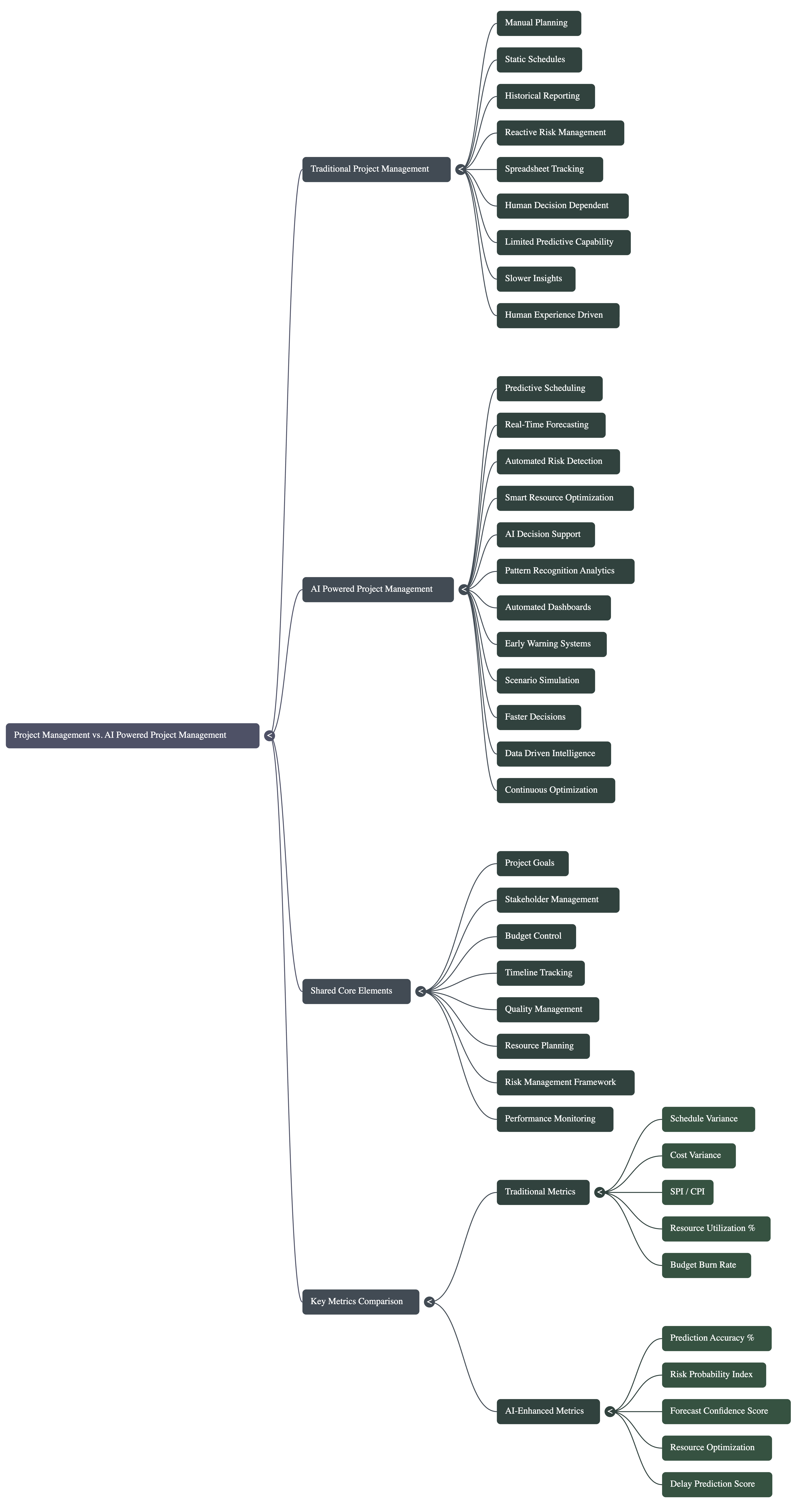
🧠 AI Mind Maps📊 AI vs Traditional PM Infographic🔍 Framework Comparisons📈 Future of PM
Leveraging Artificial Intelligence to Enhance PM Workflows
1. Visualizing Complexity with AI Generators
Project Managers are increasingly using AI tools to rapidly translate dense, complex text into visual structures, ensuring that intricate relationships between different methodologies are understood and communicated clearly.
• Rapid Visualization (Speed): AI generators (e.g., "Studio" and "NotebookLM") instantly create Mind Maps from text documents. This allows Project Managers to quickly visualize "The Big Picture," such as the complex structure of the SAFe 6.0 Framework or the hybrid "Scrum-to" Kanban process.
• Preserving Structural Quality: By using specific prompts with these AI tools, Project Managers ensure the "structural integrity" of their frameworks is preserved. For example, AI is used to correctly draw the connections between Governance (the "Crust") and Delivery (the "filling") in a Hybrid model, ensuring that the "Translation Layer" between Waterfall milestones and Agile increments is accurate. This prevents the creation of confusing "spaghetti diagrams" when dealing with massive frameworks.
2. Workflow Automation (Trello & JIRA)
While it can sometimes be categorized as "Automation" rather than generative AI, the prevalence of "smart" logic features in project management software accelerates delivery and maintains quality through standardized rules.
• Trello (Butler Automation): This tool uses "If-this-then-that" logic to speed up processes. For example, it can automatically move a card to "Ready for Review" the moment a checklist is completed.
• Quality Preservation: By automating these moves based on completed criteria (like a checklist), the tool ensures that steps are not skipped, embedding quality directly into the workflow.
• JIRA Automation: Similar to Trello, JIRA uses no-code rules to automate repetitive administrative tasks, such as closing a parent issue when all sub-tasks are done.
Summary of Tools
Tool
AI/Automation Function
Benefit to Project Manager
NotebookLM / "Studio"
Generative Visualization: Creating Mind Maps from source text
Rapidly clarifies complex frameworks and ensures structural connections are accurate
Trello (Butler)
Logic Automation: "If-this-then-that" rules for card movement
Increases speed by automating hand-offs; preserves quality by enforcing checklist completion
JIRA Automation
Task Automation: Auto-closing tasks or updating statuses
Reduces administrative drag, allowing faster delivery of "User Stories" and "Epics"
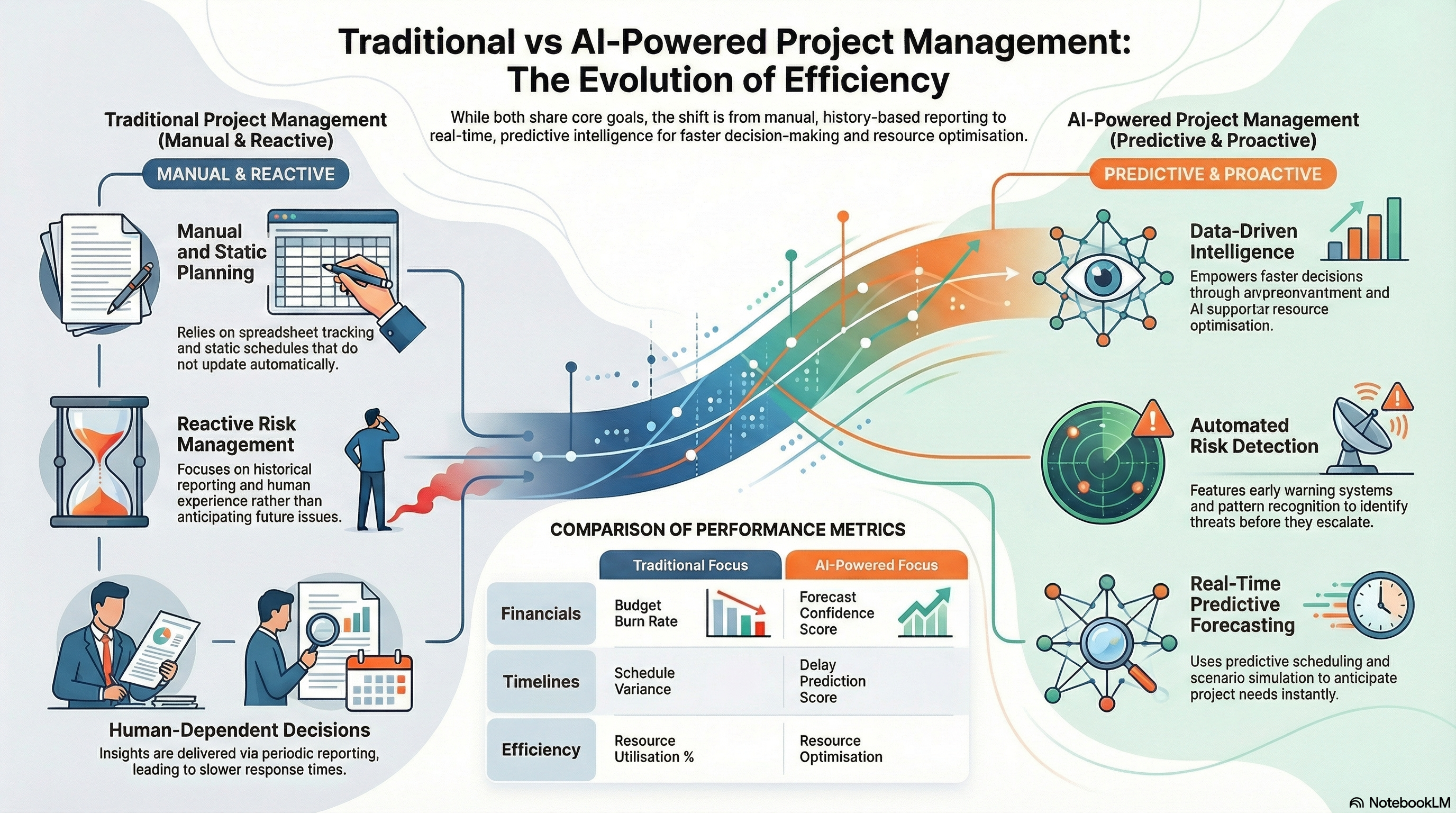
AI Impact Infographic
Visual Overview of AI Transformation in Project Management
The infographic provides a comprehensive visual representation of how AI technologies are reshaping traditional project management practices across all major methodologies.
AI in Project Management - Mind Map
100%
Mouse wheel: Zoom • Click & drag: Pan
100%
Mouse wheel: Zoom • Click & drag: Pan
🔒
Premium Content
The Competitive Edge section is available in the full version of PM Navigator.
Full version includes:
✓ AI Competitive Edge deep-dive
✓ All 12 methodology detail pages
✓ Complete mind maps & infographics
✓ Bookmark & export features
AI-Powered PM: The Competitive Edge
Working Smarter, Not Harder
The gap between traditional and AI-enabled project management is widening fast. While conventional PMs rely on manual tracking and reactive decision-making, those embracing AI are operating with foresight, speed, and precision.
Predictive Risk Detection
Traditional risk management reacts to problems after they emerge. AI continuously analyses historical data and live project signals — sprint velocity, scope creep, communication patterns — to flag bottlenecks before they escalate.
Early warnings for schedule slippage and budget overruns mean you intervene weeks ahead of a crisis, not days after one.
Intelligent Resource Optimisation
AI matches the right people to the right tasks by analysing skill sets, current workloads, and past performance. Model real-time "what-if" staffing scenarios and immediately see the impact on milestone dates — preventing burnout while maximising delivery speed.
Automated Reporting & Status Updates
Status reporting typically consumes 6–8 hours per week. AI aggregates updates from emails, Slack, JIRA, and meeting notes to produce board-ready reports automatically — turning project calls directly into tracked action items and executive summaries.
Data-Driven Estimation & Planning
Human estimation tends toward optimism. AI draws on thousands of comparable historical projects to generate realistic timelines and cost projections. Project charters shift from wishful thinking to evidence-based planning, with work breakdown structures generated from plain-language descriptions.
Scenario Analysis & Decision Support
When facing critical decisions, AI evaluates multiple scenarios and recommends optimal paths based on cost, time, and risk trade-offs.
Query your entire project history in plain language — "What caused delays in our last three system migrations?" — and get actionable answers instantly.
Organisational Knowledge, Made Accessible
Lessons learned documents gather dust in shared drives. Tribal knowledge walks out the door with departing team members. AI makes your organisation's entire project history searchable, surfacing relevant risks and patterns across similar project types automatically.
The PMs embracing these capabilities aren't simply more efficient — they're operating at an entirely different strategic level, while others are still manually updating Gantt charts.
100%
Mouse wheel: Zoom • Click & drag: Pan
🔒 Privacy Policy
Effective Date: 3 March 2026 | Last Updated: 3 March 2026
1. Introduction
PM Navigator ("the Application", "we", "us", "our") is a project management methodology reference tool available at pmnavigator.io. This Privacy Policy explains what information we collect, why we collect it, how it is used, and your rights in relation to that information.
We are committed to protecting your privacy and handling your data transparently and responsibly.
2. Who We Are
PM Navigator is operated by an individual developer based in Ireland. This application is subject to the General Data Protection Regulation (GDPR) and the Irish Data Protection Acts 1988–2018. Contact: [email protected]
3. What Information We Collect
Information You Provide Directly: When you register your interest in the full version, we collect your email address — provided voluntarily via our early access sign-up form. We do not collect your name, postal address, phone number, or any payment information at the free tier stage.
Analytics Data (Plausible Analytics): We use Plausible Analytics — a privacy-first, GDPR-compliant service that does not use cookies and does not collect or store any personally identifiable information. Data collected includes page views, general geographic region (country level only), browser type, and referring website. No individual user is tracked. No data is shared with advertising networks.
Hosting Infrastructure Logs (Vercel): Vercel automatically collects standard server access log data including IP address, date/time of access, pages requested, and browser type. This data is retained by Vercel per their own privacy policy. We do not directly access or process this log data.
4. What We Do Not Collect
No advertising or ad tracking of any kind
No Facebook Pixel, Google Ads tags, or affiliate tracking scripts
No selling or sharing of your data with third parties for marketing
No profiling or automated decision-making based on your usage
No sensitive personal data (health, financial, political, biometric, etc.)
5. How We Use Your Information
Your email address is used solely to notify you when the full version becomes available, send a one-time early access offer at launch, and communicate important application updates (infrequently and only when relevant). We will not send unsolicited marketing emails or share your address with any third party.
6. Legal Basis for Processing (GDPR)
Consent: When you submit your email address, you give explicit consent to be contacted about PM Navigator. You may withdraw consent at any time by emailing [email protected].
Legitimate interests: For aggregated, anonymised analytics data that helps us improve the application without identifying individual users.
7. Data Retention
Email addresses are retained until the full version has launched and all early adopters have been notified, after which they will be deleted unless you have explicitly opted in to ongoing communications. Analytics data is aggregated, anonymised, and contains no personal data.
8. Your Rights Under GDPR
Right of access — request a copy of the personal data we hold
Right to rectification — request correction of inaccurate data
Right to erasure — request deletion of your data
Right to restrict processing — request limits on how we use your data
Right to object — object to our processing of your data
Right to withdraw consent — withdraw at any time without affecting prior processing
To exercise any of these rights, contact us at [email protected]. We will respond within 30 days.
9. Data Security
We take reasonable technical measures to protect the data we hold. Email addresses are stored securely via our email service provider. We do not store payment card information.
10. Children's Privacy
PM Navigator is designed for professional project managers and is not directed at children under 16. We do not knowingly collect personal data from anyone under 16.
11. Changes to This Policy
We may update this Privacy Policy as the application evolves. When we do, we will update the Last Updated date above. For significant changes, we will notify registered email subscribers directly.
Effective Date: 3 March 2026 | Last Updated: 3 March 2026
1. Acceptance of Terms
By accessing or using PM Navigator at pmnavigator.io ("the Application"), you agree to be bound by these Terms and Conditions. If you do not agree, please do not use the Application.
2. Description of Service
PM Navigator is a project management methodology reference tool providing educational content about project management frameworks, methodologies, and best practices. It is intended for professional project managers, PMP exam candidates, and PM methodology researchers.
3. Free Tier and Paid Access
The Application is available in a free tier with limited functionality. Full access requires a one-time purchase. Pricing and feature availability are subject to change with reasonable notice to registered users. Early access registrants will be notified of any changes before they take effect.
4. Intellectual Property
All content within PM Navigator — including methodology descriptions, mind maps, infographics, and application code — is the intellectual property of PM Navigator and its developer unless otherwise stated. You may not reproduce, distribute, or create derivative works from this content without express written permission.
Project management framework names (PRINCE2, SAFe, PMBOK, etc.) are the trademarks of their respective owners. PM Navigator is an independent reference tool and is not affiliated with, endorsed by, or officially associated with any methodology framework body.
5. Disclaimer of Warranties
PM Navigator is provided "as is" and "as available" without warranties of any kind, either express or implied. We do not warrant that the Application will be uninterrupted, error-free, or completely accurate. Content is provided for educational and reference purposes only and should not be relied upon as professional project management advice.
6. Limitation of Liability
To the fullest extent permitted by applicable law, PM Navigator and its developer shall not be liable for any indirect, incidental, special, consequential, or punitive damages arising from your use of, or inability to use, the Application.
7. PMP Exam Content Notice
Content relating to the PMP examination and PMBOK Guide is provided for general educational reference only. PM Navigator is not an official PMI-authorised exam preparation provider. For official PMP exam preparation, refer to PMI-accredited resources.
8. Privacy
Your use of the Application is also governed by our Privacy Policy, which is incorporated into these Terms by reference. Please review our Privacy Policy to understand our data practices.
9. Governing Law
These Terms and Conditions are governed by and construed in accordance with the laws of Ireland. Any disputes arising from these Terms shall be subject to the exclusive jurisdiction of the Irish courts.
10. Changes to Terms
We reserve the right to modify these Terms at any time. Changes will be posted